

Selling the Thing vs Selling the Outcome: Why Marketing a Service Is Different From Marketing a Product
Visual Marketing Lab Insights
Here's a question we've been thinking about in the Lab:
Do people NEED products but WANT services?
At first, it made quite a lot of sense.
Take pest control.
You need something that's going to get rid of the rats.
But what you really want is somebody else to come into your property, work out what's happening, deal with it properly and make the problem disappear.
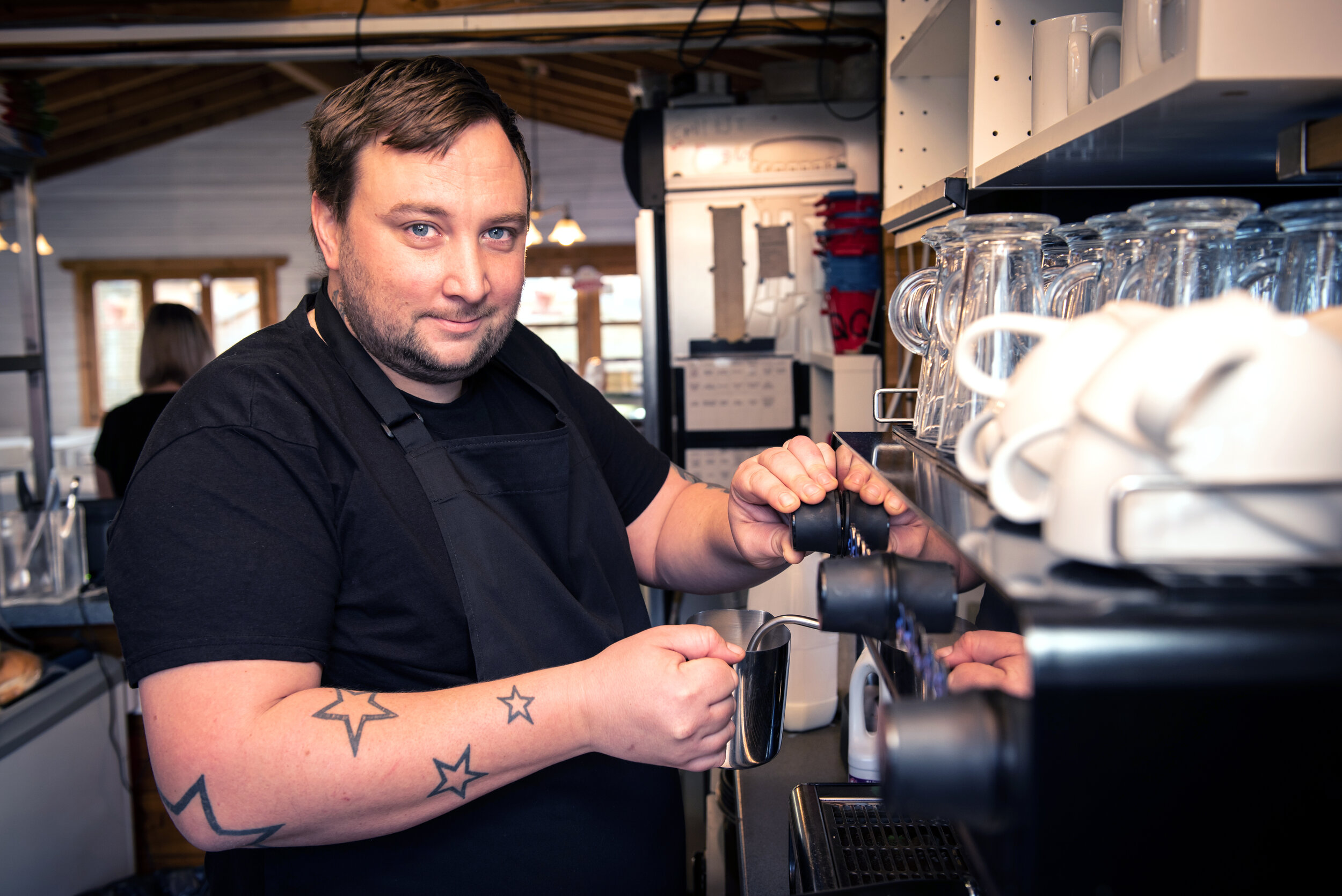
Photography?
You probably don't need somebody to take a photograph of you.
But you might want a photographer who can make you look professional, confident and credible.
And then there's a packet of sweets.
You might think you need them because you're craving sugar.
But do you really?
Probably not.
And that's where our original theory started falling apart.
Which is exactly what we like about the Lab.
Test the idea. Challenge it. Find something better.
And we think we've found it.
Customers Don't Really Buy Products OR Services
They buy outcomes.
That packet of sweets?
You're buying a moment of pleasure.
Pest control?
You're buying a pest-free home.
Photography?
You're buying how you want your business to be perceived.
A drill?
You're buying a hole.
Accountancy?
You're buying financial clarity, compliance or peace of mind.
A coffee?
You're buying energy, taste, routine or perhaps ten minutes away from your desk.
A gym membership?
You're buying the possibility of becoming fitter.
Once you start looking at marketing this way, something interesting happens.
The distinction between products and services becomes less important.
The customer's desired outcome becomes much more important.

But There IS a Big Difference Between Marketing Products and Services
And it comes down to something incredibly important:
Certainty.
Imagine you're buying a camera.
You can see it.
Pick it up.
Read the specifications.
Look at photographs of it.
Watch reviews.
Compare it with another camera.
Check the dimensions.
Read hundreds of customer reviews.
You have lots of evidence about what you're buying.
Now imagine you're choosing a photographer.
Before you book them, the photographs they're going to create for you don't exist.
You're effectively buying a promise.
Marketing theory describes this as the intangibility of services.
Unlike a physical product, a service often can't be properly inspected before you buy it.
That creates uncertainty.
And uncertainty changes the job marketing has to do.
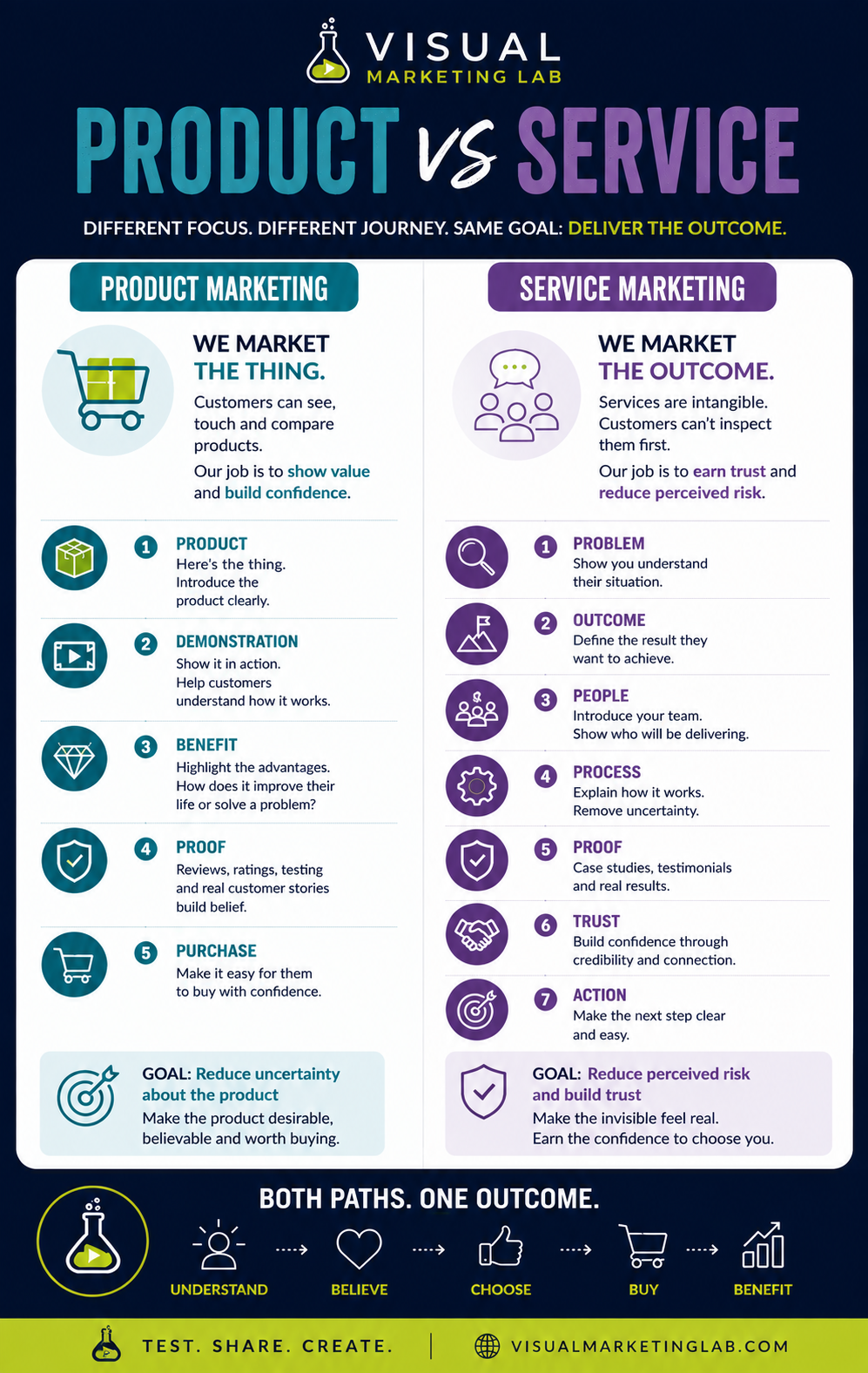
PRODUCT MARKETING
"Here's the thing."
Product marketing can often focus heavily on the object itself.
What is it?
What does it do?
What does it look like?
How much does it cost?
How is it better?
What features does it have?
What problem does it solve?
Imagine we're selling a cordless drill.
We can show:
The drill
The battery
The chuck
The controls
The accessories
The specifications
The drill working
The finished hole
Customer reviews
The product provides a huge amount of the evidence.
That's why product photography is so important.
The customer can't physically pick up an online product, so great photography has to become their eyes.
Video can then go further by demonstrating the product in use.
SERVICE MARKETING
"Here's what we can do for you."
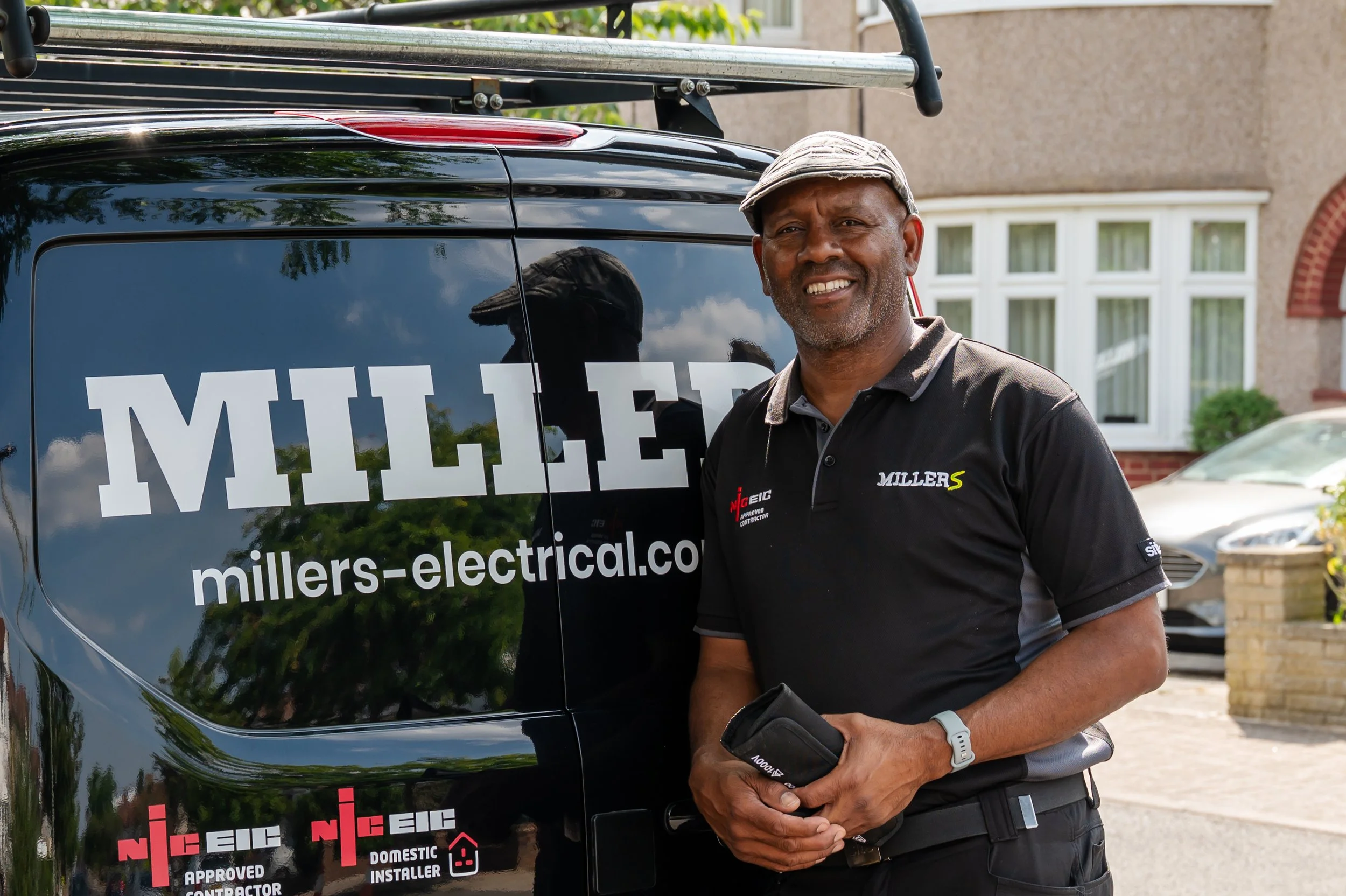
Now imagine we're marketing an electrician.
What exactly are we photographing?
A screwdriver?
A fuse box?
A van?
They're useful supporting assets.
But they're not really what the customer is buying.
They're buying:
Expertise.
Reliability.
Safety.
Problem solving.
Convenience.
Confidence that the job will be done properly.
And that's why service marketing has an additional challenge.
You have to make something intangible feel tangible.
The Pest Control Test
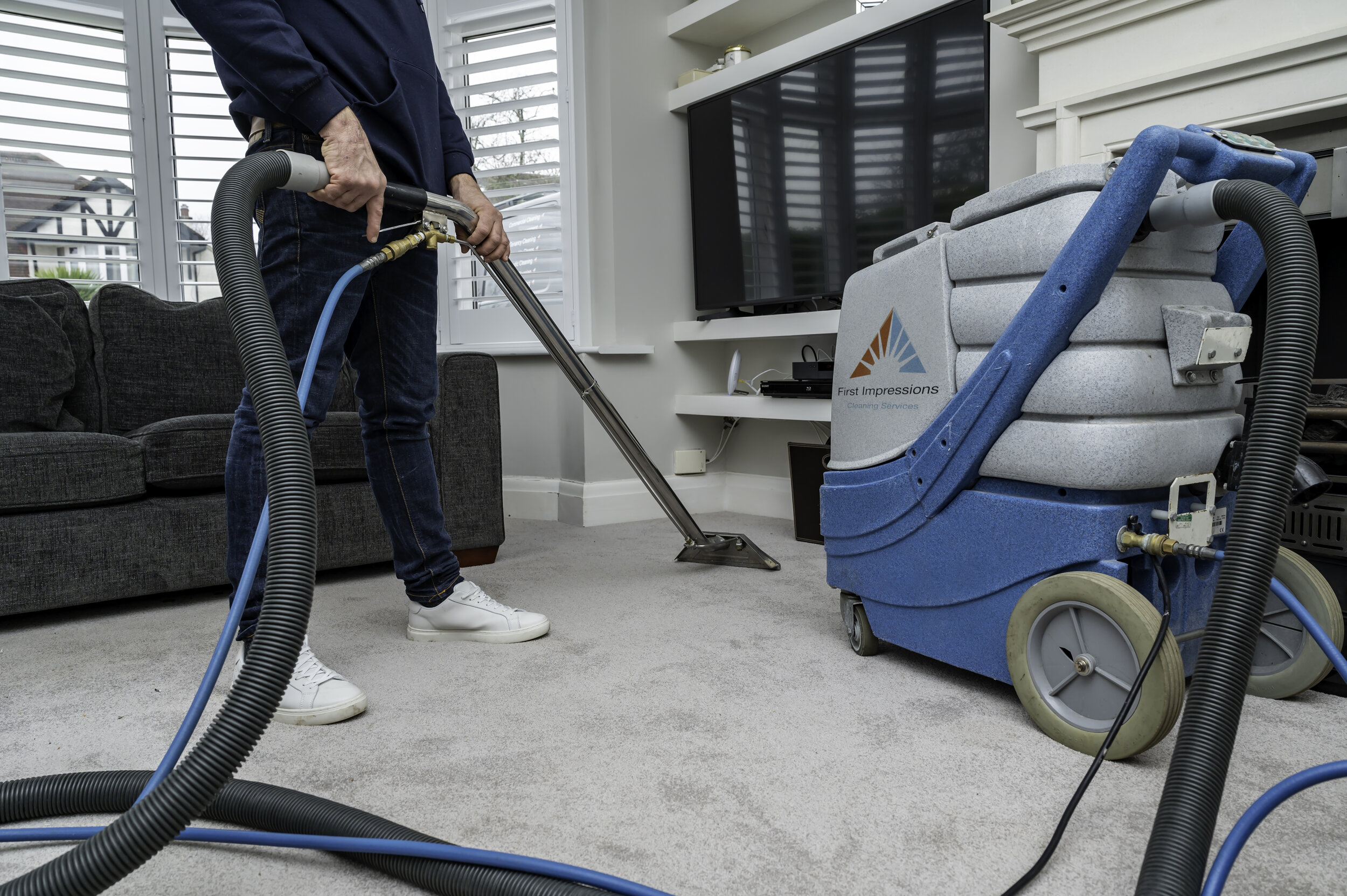
Let's go back to pest control because it's a brilliant example.
Imagine a pest control company's marketing says:
"We provide professional pest control services."
Technically correct.
Emotionally?
Not particularly interesting.
What does the customer actually want?
They might be thinking:
"I heard scratching in the loft last night."
"I've just seen a rat in the kitchen."
"Customers can't see this in my restaurant."
"I want this sorted TODAY."
They're not particularly interested in buying "pest control services."
They want:
THE RAT GONE.
That's the outcome.
But there's another layer.
They probably also want:
Someone to respond quickly
Someone who knows what they're doing
Someone who won't judge them
Someone who can explain what happened
Someone who can stop it happening again
Someone they feel comfortable allowing into their property
Suddenly we're no longer marketing chemicals, traps or equipment.
We're marketing the transformation from problem → solved.
NEED vs WANT Isn't Quite Enough
This was the part of our original theory that needed challenging.
Because purchases usually contain elements of both.
You might need pest control...
…but want someone trustworthy, discreet and quick.
You might need new corporate headshots...
…but want photographs that make your team look confident, approachable and professional.
You might need accounting software...
…but want to stop worrying about your finances.
You might not need sweets at all...
…but strongly want the feeling they give you.
So perhaps a better framework is:
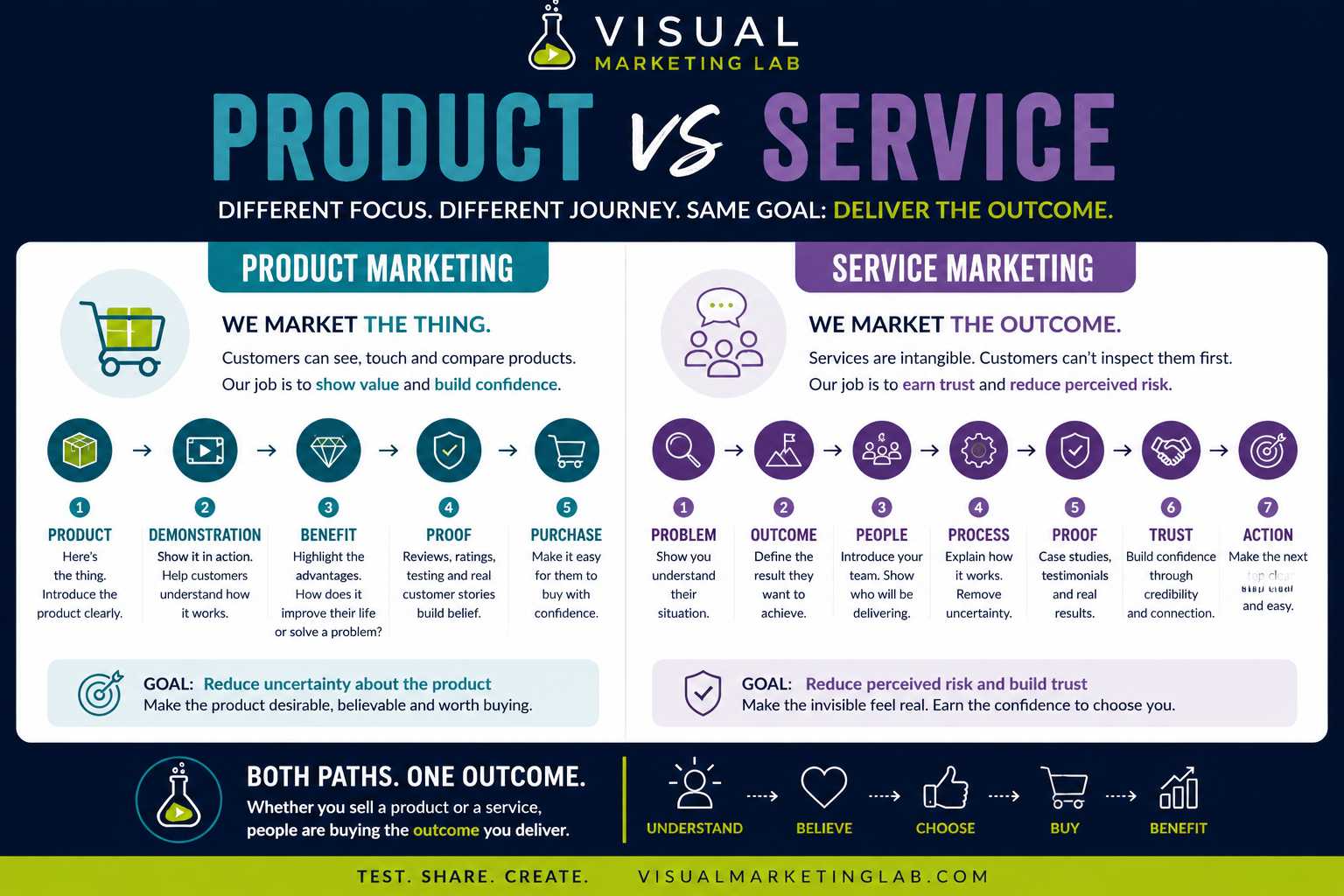
PROBLEM → DESIRED OUTCOME → TRUST → CHOICE
And that becomes particularly powerful for service businesses.
The Service Marketing Trust Gap
Here's where service marketing gets really interesting.
Research into services marketing identifies four characteristics traditionally associated with services:
Intangibility
You often can't see the service before buying it.
Inseparability
The person delivering the service can be part of the experience.
Variability
The experience can differ depending on who delivers it and how.
Perishability
An unused appointment or service capacity can't necessarily be stored and sold tomorrow.
For the customer, these characteristics create something very simple:
Risk.
"Will they actually be any good?"
"Will they turn up?"
"Will I like working with them?"
"Will I get the result?"
"What happens if something goes wrong?"
Which means service marketing has another job.
Reduce perceived risk.
That's why your people, reviews, testimonials, case studies, processes, qualifications and previous work become so important.
They're evidence for something the customer cannot inspect yet.
Photography and Video Have Different Jobs Here
This is where visual marketing becomes incredibly powerful.
Photography says:
"This is us."
Show me:
Your people
Your workplace
Your equipment
Your customers
Your process
Your finished work
Your environment
Behind the scenes
Before and after
The details
Photography makes the business feel real.
Video says:
"This is what it's like to work with us."
Now I can:
Hear you speak
See your personality
Watch your process
Hear a customer describe their experience
Watch you solve a problem
Understand something complicated
See the transformation
Build familiarity with you
That's incredibly powerful for services.
You're effectively allowing somebody to experience part of the service before they've bought it.

Product Marketing Needs Demonstration
If you're selling products, your visual strategy should answer:
WHAT IS IT?
Show the product clearly.
WHAT DOES IT DO?
Demonstrate it.
WHY IS IT BETTER?
Show differences and benefits.
WHAT WILL IT DO FOR ME?
Show the outcome.
CAN I TRUST IT?
Show reviews, demonstrations, testing and real-world use.
This gives us a simple product-content formula:
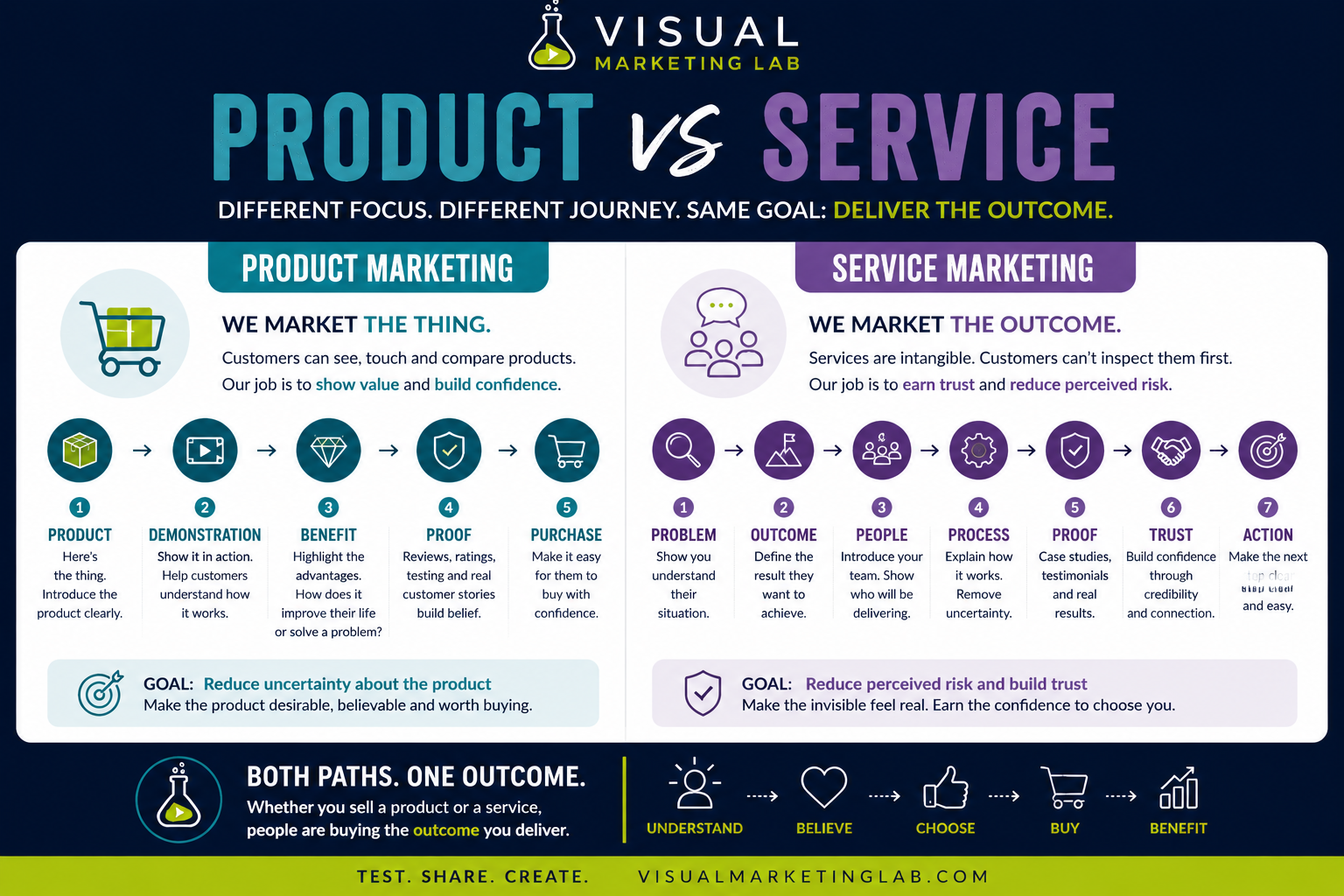
PRODUCT → DEMONSTRATION → BENEFIT → PROOF → PURCHASE
Service Marketing Needs Reassurance
Services need a slightly different journey.
WHAT PROBLEM DO YOU UNDERSTAND?
Show the customer you understand their situation.
WHAT OUTCOME CAN YOU HELP CREATE?
Don't just describe the service.
Show the transformation.
WHO WILL I BE DEALING WITH?
Make your people visible.
HOW DOES IT WORK?
Remove uncertainty by explaining your process.
HAVE YOU DONE IT BEFORE?
Case studies.
WHAT DO YOUR CUSTOMERS SAY?
Testimonials.
WHAT HAPPENS NEXT?
Give them an obvious action.
That gives us:
PROBLEM → OUTCOME → PEOPLE → PROCESS → PROOF → TRUST → ACTION
And if you're marketing a service business, we'd argue that this is considerably more useful than repeatedly posting:
"Here's another service we offer."
Let's Test It With Photography
A photography business could advertise:
"Corporate photography packages from £XXX."
That's selling the service.
But what does the customer want?
Perhaps:
"We want our website to finally look like the quality of business we've become."
That's an outcome.
Or:
"We need enough professional visual content to market ourselves consistently for the next six months."
Outcome.
Or:
"Our team hate having their photographs taken and we need somebody who can make everyone comfortable."
Problem + desired outcome.
That's much more interesting marketing.
You're not really selling shutter clicks.
You're selling:
Confidence.
Credibility.
Visibility.
Consistency.
A stronger perception of the business.
The photographs are the deliverable.
The outcome is why the customer buys.
Now Test It With a Product
Imagine we're selling a premium coffee machine.
We could market:
19-bar pressure.
1.8-litre water tank.
Integrated milk system.
Useful.
But what does the customer really want?
Maybe it's:
"Coffee-shop-quality coffee without leaving home."
Now the specifications become proof of the outcome, rather than the entire marketing message.
That's an important distinction.
Because even product marketing gets stronger when we stop simply selling the product.
The Visual Marketing Lab Rule
Here's the idea we're taking away from this experiment:
DON'T MARKET WHAT YOU SELL.
MARKET WHY SOMEONE WANTS IT.
Then use your product, service, people, process and evidence to prove you can deliver it.
For a product business:
Show me the thing.
Show me it working.
Show me the result.
Give me proof.
For a service business:
Show me you understand my problem.
Show me the outcome.
Show me who's going to deliver it.
Show me how.
Show me someone you've already helped.
Make me trust you.
Try This With Your Own Business
Write down the service or product you sell.
Now finish these sentences:
My customer comes to me because ________.
The problem they're actually trying to solve is ________.
What they really want afterwards is ________.
The thing they're worried about before buying is ________.
The evidence they need to feel comfortable is ________.
That final answer should influence your marketing content.
If customers need to see quality?
Create photography.
If they need to understand something?
Create educational video.
If they need reassurance?
Create testimonials.
If they're worried about the process?
Show behind the scenes.
If they're worried about whether it works?
Create a case study.
If they need to see the difference?
Create before-and-after content.
Suddenly you're not creating content because:
"We haven't posted anything this week."
You're creating content to remove specific barriers to buying.
Final Thought
Maybe the biggest difference between product and service marketing isn't need vs want after all.
It's certainty vs uncertainty.
With a physical product, customers can often see much of what they're buying.
With a service, they're frequently buying something that hasn't happened yet.
They're buying a promise of an outcome.
And that means your marketing needs to make that future outcome feel believable.
Show the people.
Show the process.
Show the evidence.
Show the transformation.
And give your potential customer enough confidence to think:
"These are the people I trust to get me from where I am now to where I want to be."
That's not simply selling a service.
That's marketing an outcome.
Test. Share. Create.

The Aim Of Create The Image
Become the UK’s most trusted strategy-first visual marketing partner
Trusted by 100’s of businesses for
Strategy First Marketing
Creating Scroll-Stopping Content
Visual Marketing That Works
Testing Better Marketing